
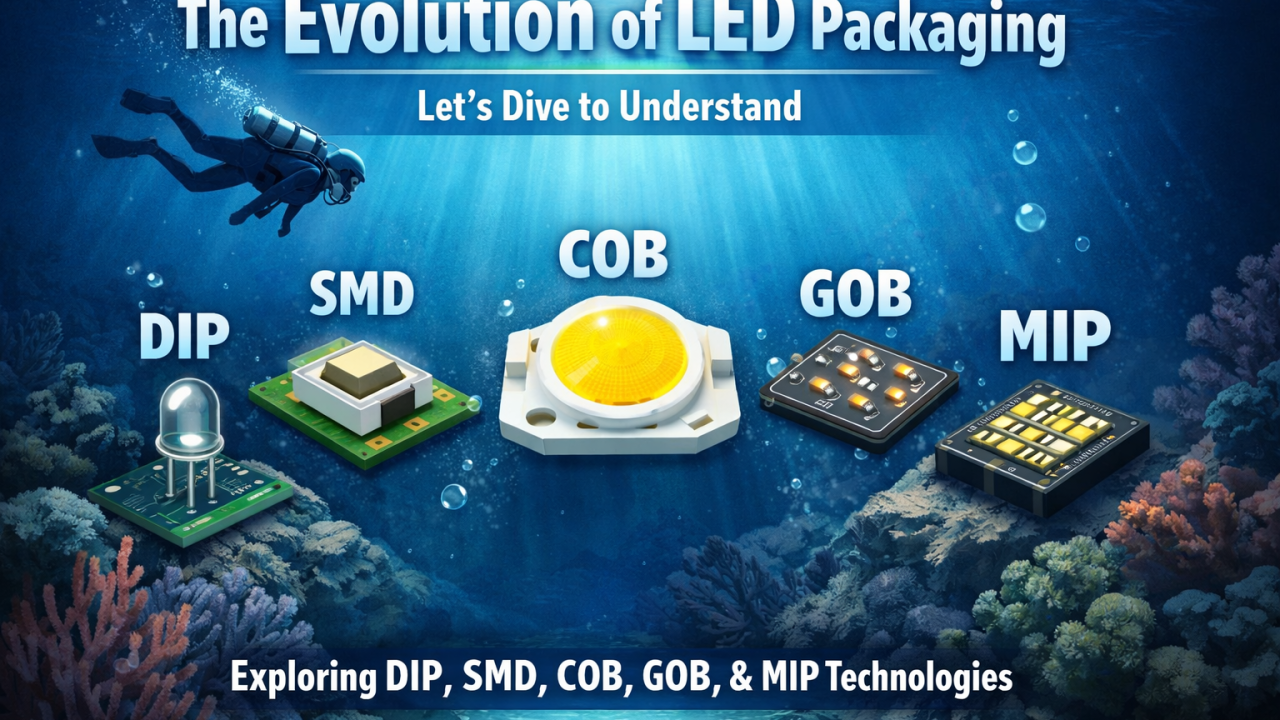
LED típiusok fejlődése

Sandeep Mali
CTO & Technical Director || LED Display Innovator | Building Next-Gen Solutions for Indian Projects || Driving Innovation to Develop the Nation | #LEDEntrepreneur
2026. február 15.
A LED típiusok fejlődése az iparág folyamatos innovációját tükrözi, amely a jövő világítási megoldásainak alapját képezi.
Light Emitting Diodes (LEDs) have revolutionized the display and lighting industries with their energy efficiency, longevity, and vibrant colors. However, the performance and reliability of an LED display heavily depend on its packaging technology. This article will provide a detailed explanation of the major LED packaging techniques: DIP, SMD, COB, GOB, and the emerging MIP, exploring their construction, working principles, advantages, disadvantages, and suitability for various applications.
LED Packaging Structure & Process Development
LED packaging refers to the process of enclosing LED chips within a protective package or module that provides electrical connections, thermal management, and optical functionality. The development status and trends in LED packaging involve advancements in packaging structures, manufacturing processes, and emerging technologies. Here’s an overview.
1. Dual In-line Package (DIP) LED
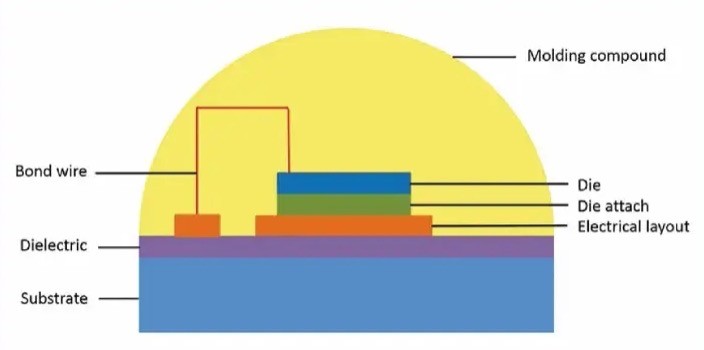
DIP LED technology is one of the oldest and most mature packaging methods. It involves encapsulating the LED chip within a hard plastic casing with two parallel rows of connecting pins.
Construction and Cross-Sectional View:
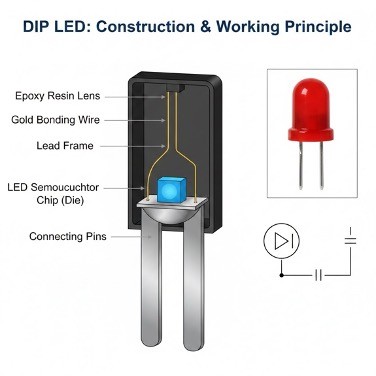
The core of a DIP LED is a semiconductor chip (die) mounted on a lead frame. Gold bonding wires connect the chip to the pins, which are then encapsulated in an epoxy resin lens that protects the chip and helps direct the light.
Working Principle: When an electrical current is applied across the connecting pins, it flows through the lead frame to the LED semiconductor chip. The chip then emits light through the phenomenon of electroluminescence. The epoxy lens focuses and diffuses this light.
Advantages:
- High Brightness: Historically, DIP LEDs were known for their brightness, making them suitable for outdoor applications.
- Good Heat Dissipation: The design allows for relatively good heat dissipation compared to early SMD designs.
- Robustness: The sturdy package offers good protection to the LED chip.
- Cost-Effective for Large Pixels: For applications requiring larger pixel pitches, DIP LEDs can be more economical.
Disadvantages:
- Large Pixel Pitch: DIP LEDs are larger, limiting the achievable pixel density and resolution.
- Limited Viewing Angle: The fixed lens design often results in a narrower viewing angle.
- Lower Uniformity: Achieving uniform brightness and color across a large DIP display can be challenging due to individual LED variations.
- Complex Assembly: Installation typically involves through-hole soldering, which can be more labor-intensive than surface-mount techniques.
Applications: Mainly used in large outdoor LED displays, traffic lights, and early generations of advertising screens where high resolution is not paramount.
2. Surface-Mount Device (SMD) LED
SMD LED technology revolutionized the industry by allowing LEDs to be mounted directly onto the surface of a Printed Circuit Board (PCB). This paved the way for higher resolution and more compact displays.
Construction and Cross-Sectional View:
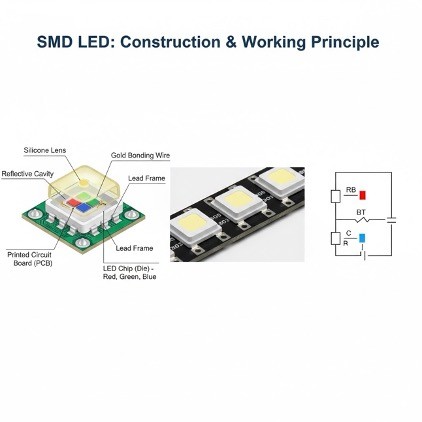
SMD LEDs typically integrate multiple LED chips (usually red, green, and blue for full-color displays) into a single package. These chips are mounted on a lead frame within a reflective cavity, connected by gold bonding wires, and then encapsulated with a silicone lens.
Working Principle: Similar to DIP LEDs, current flows through the lead frame to the individual RGB chips, causing them to emit light. The reflective cavity enhances light output, and the silicone lens provides protection and light distribution. By varying the intensity of red, green, and blue light, a wide spectrum of colors can be produced.
Advantages:
- Smaller Pixel Pitch & Higher Resolution: The compact size allows for much higher pixel densities, leading to sharper images.
- Wider Viewing Angle: The flat, multi-chip design generally offers a wider viewing angle compared to DIP LEDs.
- Better Color Uniformity: Integrating RGB chips into one package improves color mixing and uniformity.
- Automated Assembly: SMD components are ideal for automated pick-and-place manufacturing, reducing production costs.
- Versatility: Suitable for both indoor and outdoor displays, as well as various lighting applications.
Disadvantages:
- Vulnerability to Impact: The exposed individual SMD packages can be more susceptible to physical damage.
- Heat Management: While generally good, high-density SMD arrays can still pose thermal challenges.
- „Lamp Effect” at Close Viewing: For very close viewing distances, individual SMD lamps can sometimes be visible, affecting smoothness.
Applications: Widely used in indoor and outdoor LED displays, fine-pitch displays, LED strips, automotive lighting, and general illumination.
3. Chip-on-Board (COB) LED
COB LED technology takes integration a step further by directly mounting multiple LED chips onto a PCB to form a single module. This eliminates individual LED packages, leading to a smaller footprint and improved performance.
Construction and Cross-Sectional View:
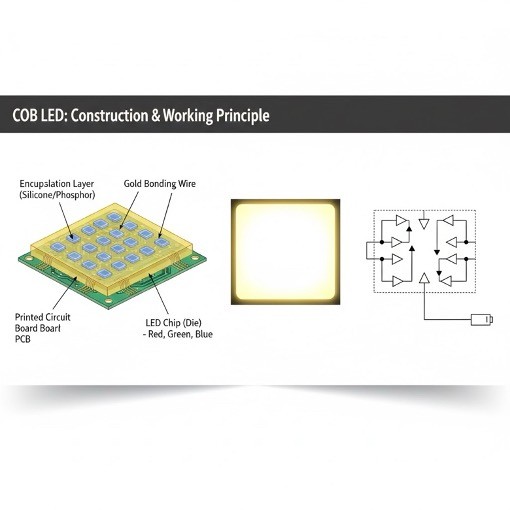
Multiple bare LED chips (RGB or single color) are directly mounted onto a single substrate (PCB) using conductive adhesive. These chips are then wire-bonded and covered with a layer of encapsulating material, often silicone or a phosphor blend (for white light COBs), to protect them and diffuse the light.
Working Principle: The COB module acts as a single, large light source. Current is supplied to the array of chips on the PCB, causing them to emit light. The encapsulating layer mixes the light from the individual chips, creating a uniform and intense light output.
Advantages:
- Ultra-Small Pixel Pitch & Higher Resolution: By eliminating individual packages, COB enables significantly smaller pixel pitches, leading to incredibly high-resolution displays.
- Superior Durability & Protection: The encapsulating layer provides excellent protection against dust, moisture, and physical impact.
- Better Heat Dissipation: Direct bonding to the PCB and a larger effective heat sink area result in more efficient heat dissipation.
- Improved Reliability: Fewer solder points and better heat management contribute to a longer lifespan.
- Wider Viewing Angle & Better Uniformity: The integrated design and common encapsulation lead to a very wide viewing angle and exceptional color uniformity.
- Smooth Surface: The lack of individual LED outlines creates a smoother, more seamless display surface.
Disadvantages:
- Higher Upfront Cost: COB modules can be more expensive to manufacture, especially for repair or replacement of individual pixels.
- Repair Challenges: Repairing a single damaged chip within a COB module can be difficult or impossible, often requiring module replacement.
- Initial Color Consistency Issues: Achieving perfect color consistency across different COB batches can sometimes be challenging, though this is improving.
Applications: High-end indoor fine-pitch displays, control rooms, broadcasting studios, virtual production, high-power lighting fixtures, and automotive headlights.
4. Glue on Board (GOB) LED
GOB technology is not a primary LED packaging method but rather a protective enhancement applied to existing SMD or COB modules. It involves covering the entire display module with a layer of transparent epoxy resin or glue after the LEDs have been mounted.
Construction and Working Principle:
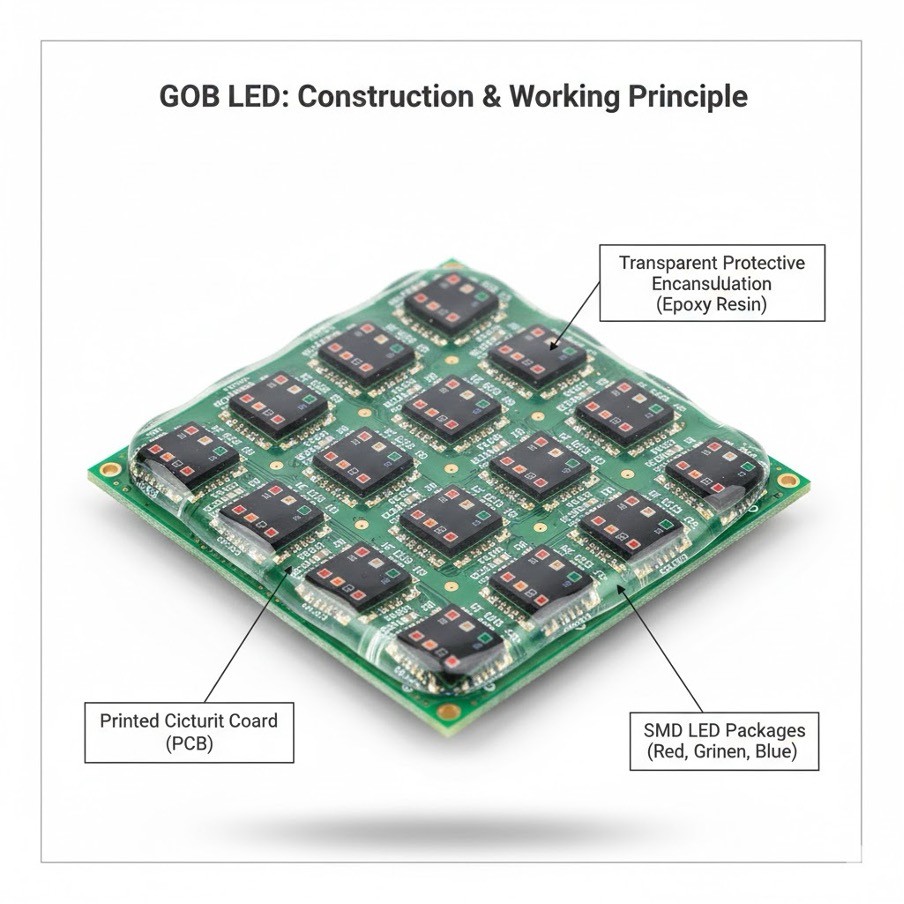
After the SMD LEDs (or COB modules) are soldered onto the PCB, a special transparent adhesive (often a proprietary epoxy resin) is uniformly applied over the entire surface of the module, completely encapsulating the LEDs and the exposed PCB traces. This layer hardens, creating a durable, protective barrier.
Advantages:
- Enhanced Protection: Provides excellent resistance against impact, moisture, dust, and UV radiation, significantly improving the display’s durability.
- Improved Reliability: Protects the delicate SMD packages from damage, leading to a longer lifespan and reduced failure rates.
- Easier Cleaning: The smooth, sealed surface is much easier to clean without risking damage to individual LEDs.
- Suitable for Harsh Environments: Ideal for outdoor applications, rental displays, and public areas where displays are more prone to damage.
- Better Contrast (with black glue): Some GOB processes use tinted glue (e.g., black) to improve contrast ratios.
Disadvantages:
- Potential for Reflection: The transparent layer can sometimes introduce reflections, especially in brightly lit environments.
- Increased Weight: The added layer of glue slightly increases the overall weight of the module.
- Repair Difficulty: If an LED fails beneath the GOB layer, repair can be very challenging or impossible, often requiring module replacement.
- Heat Dissipation Consideration: While the glue protects, it can also slightly impede heat dissipation if not properly formulated.
Applications: Outdoor rental LED displays, transparent displays, sports stadiums, stage backdrops, and any application requiring enhanced durability and protection for SMD LED screens.
5. Micro LED in Package (MIP)
MIP technology is a significant step towards the future of Micro LED displays. It involves packaging tiny Micro LED chips into a standard LED package (similar to an SMD package) before mounting them onto a PCB. This bridges the gap between the extremely small size of Micro LEDs and the established manufacturing processes of SMD.
Construction and Working Principle:
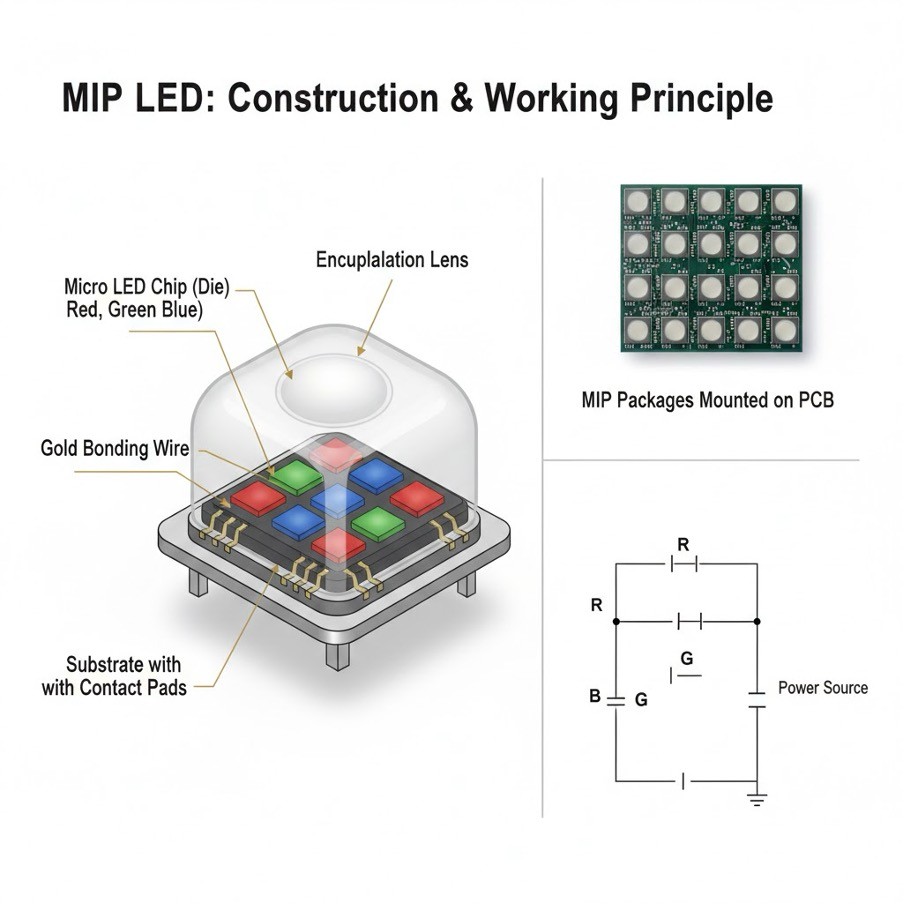
MIP involves placing individual Micro LED chips (which are incredibly small, typically 5-50 micrometres) onto a tiny sub-substrate or carrier within a conventional LED package. These Micro LEDs are wire-bonded to contact pads on the sub-substrate, and the entire assembly is then encapsulated with a lens. These MIP packages can then be handled and mounted on a standard PCB using existing SMD assembly equipment.
Advantages:
- Leverages Existing Infrastructure: Allows manufacturers to utilize their current SMD pick-and-place and reflow soldering equipment, significantly reducing the entry barrier for Micro LED production.
- Repairability: Unlike direct transfer Micro LED (COB-like Micro LED), individual MIP packages can be replaced, simplifying maintenance and repair.
- High Resolution: Inherits the core advantage of Micro LEDs – enabling extremely high pixel densities and resolutions.
- High Brightness & Contrast: Micro LEDs offer superior brightness, contrast, and color saturation.
- Energy Efficiency: Micro LEDs are inherently more energy-efficient than traditional LEDs.
- Scalability: Allows for the production of large-format Micro LED displays by assembling many MIP modules.
Disadvantages:
- Additional Packaging Step: The intermediate packaging step adds complexity and cost compared to direct Micro LED transfer.
- Slightly Larger Footprint than True COB Micro LED: While tiny, the MIP package is still larger than directly transferred bare Micro LED chips in a true COB Micro LED display.
- Yield Challenges: Manufacturing Micro LED chips and packaging them reliably still presents yield challenges.
- Developing Technology: Still a relatively new and evolving technology, with ongoing research to optimize processes and reduce costs.
Applications: Fine-pitch LED displays, large-format commercial displays, next-generation televisions, virtual reality/augmented reality devices, and potentially even smartphones and wearables.
Conclusion: Reliability and Future Advancement
The evolution of LED packaging reflects a continuous drive towards higher resolution, greater durability, and improved efficiency.
- DIP is largely a legacy technology, still found in some robust, large-pixel outdoor applications due to its brightness and traditional reliability. However, its limitations in resolution and viewing angle make it unsuitable for modern, high-definition displays.
- SMD remains the workhorse of the LED display industry. It offers an excellent balance of resolution, brightness, cost-effectiveness, and automation for a vast range of indoor and outdoor applications. Its reliability is generally good, though vulnerable to direct physical impact.
- COB significantly enhances reliability and durability due to its integrated, encapsulated design. It excels in extreme fine-pitch applications, offering superior protection against dust, moisture, and impact, along with excellent heat dissipation. Its primary drawback is the challenge of individual pixel repair, often necessitating module replacement. COB is highly reliable for demanding applications.
- GOB is a protective layer, not a core packaging technology. It boosts the reliability and robustness of SMD displays, making them suitable for harsh environments and rental applications where physical damage is a concern. While it adds a layer of protection, it also complicates repairs under the encapsulated layer.
- MIP represents a crucial bridge to the future of Micro LED. By packaging ultra-small Micro LEDs into conventional packages, it allows the industry to leverage existing manufacturing infrastructure, accelerating the adoption of Micro LED technology. MIP promises unparalleled resolution, brightness, and energy efficiency, along with improved repairability compared to early direct-transfer Micro LED approaches.
In terms of reliability:
- COB generally offers the highest inherent reliability due to direct chip-on-board mounting, superior heat dissipation, and comprehensive encapsulation.
- GOB-enhanced SMD displays are also highly reliable, particularly against external environmental factors and physical damage.
- MIP is poised to offer excellent reliability once mass production processes are fully matured, benefiting from Micro LED’s intrinsic robustness and the relative ease of package replacement.
For future advanced technology: MIP (Micro LED in Package) is undoubtedly the most advanced and future-oriented technology discussed. It is a critical stepping stone towards widespread adoption of Micro LED, which is considered the ultimate display technology due to its superior performance in every key metric: brightness, contrast, color accuracy, resolution, power efficiency, and longevity. While direct transfer Micro LED (true COB Micro LED without intermediate packaging) is the eventual goal for ultimate miniaturization, MIP makes Micro LED a practical reality for today and the immediate future by solving critical manufacturing and repair challenges. As Micro LED manufacturing matures and costs decrease, MIP will pave the way for a new generation of stunning, high-performance displays across countless applications.